By the time I've posted this, my springtime trip to Central Asia seems like a very long time ago. It was quite a journey to get there, but I was greeted by the friendliest of faces -- my dear sweet former colleague and housemate in Aceh, Elzat. She and her husband have been bouncing around the region the past few years as she's helped lead disaster preparedness throughout the region. I came to help them with some public awareness efforts, and though I met folks from each country involved in the project, I only traveled to Tajikistan and Kazakhstan. For the record, I did not see Borat or anyone who resembled anything in that disastrous movie. People were kind and gracious and very smartly dressed. I spent an incredible amount of time not knowing what anyone was saying, but that's totally fine. I did learn a whopping two words of Russian in the process.
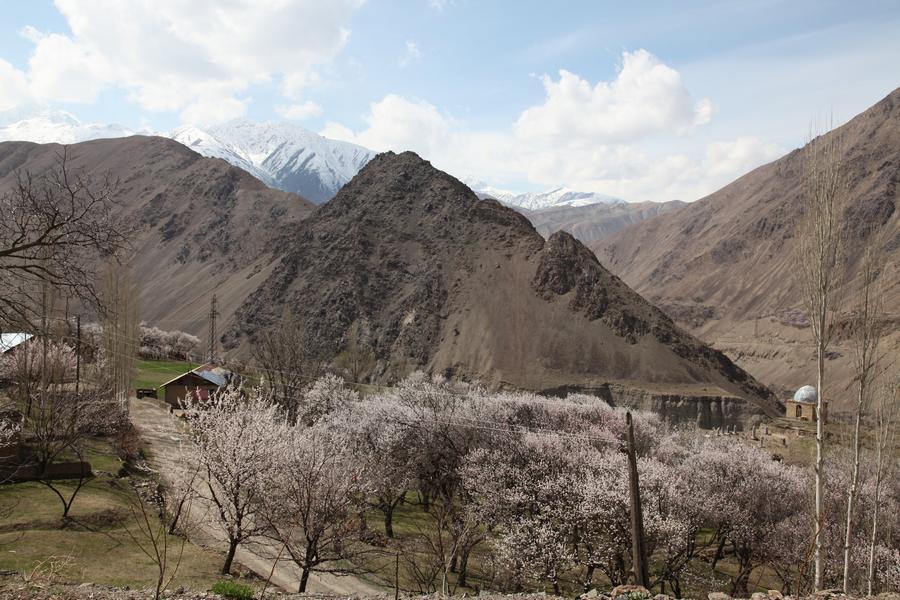
The photos that follow are from Tajikistan, where we road tripped through one of the world's most disaster prone regions... Click on the photo for a larger view.
Within an hour or so from the capital city, we were careening through ice-covered roadways.
The further we traveled, the more spectacular the views became.
Oh, Nigeria. I left you only months before with exalted hopes and shattered stereotypes. Little did I know you were not finished with me yet... This was a tough trip. A long trip. Confessionally, I dealt very poorly with the daily, mounting frustrations and aggravations. I even started writing a blog entry on the flight home, only to read it later and wince at my own incessant complaining. When truly, any trip, any new experience, any chance to see another corner of the globe is a blessing. We covered a lot of ground -- Abuja, Ibadan, Ilorin and Kaduna, and in the shots below you'll see glimpses of each. Cute kids (I can't help myself), open air cooking (including my favorite suya), the markets, women entrepreneurs, local leaders in traditional clothes (I was repeatedly told that Nigerians are the best dressed people in Africa,) the rusty rooftops of Ibadan (once Africa's largest city), gigantic yams, and much more. Enjoy the mini-tour!
How many flashlights do you have? Personally, I have about 10, counting the normal size ones (mostly with corroded batteries), the one on my keychain, my headlamp and camping lantern. On the off-chance there is ever a power outage, I will certainly be well-lit!
What about you? Is there a surplus of lighting devices in your life? Before you answer, let me share a little bit about why I’m asking.
Some of you may know that I went to Kenya recently to report on a treatment project for malaria, which is the leading cause of death for children there. Volunteers with the Kenya Red Cross were trained to treat sick kids in some of the most remote and poor villages in the country, and their work was having incredible results. After only 18 months, the number of children dying had dropped dramatically and more than 80 percent of kids were receiving treatment within 24 hours, the pivotal time window when malaria infections become deadly. This life-saving success was a direct result of a small army of dedicated volunteers, and I was blessed to hear their stories.
The volunteers were individually selected by community members where they served, nominated because they were trusted and respected by their neighbors, friends and families. They all have other jobs as farmers or teachers, shop-keepers or students, and the work they do as on-call “little doctors” in their villages is strictly voluntary. When they get a knock on the door in the middle of the night, they go. When they’ve treated a sick child, they go back to follow-up and ensure treatment is continuing, not once, not twice, but three times, along with keeping detailed records that would rival any doctor’s office anywhere in the world.
They are typically the only health care providers of any kind within twenty or even thirty miles -- and that’s on foot! Before the project started, if you were a mother with two sick kids, you would carry one on your back and one on your shoulders to the nearest clinic, regardless of how far it was, so that your child would get treatment. But now, mothers only have to alert their local volunteer to ensure their kids are cared for. No more long journeys required.
But it is the volunteers, though, who are called out at night by text message or by concerned family members, to rush out into the darkness with their kits of life-saving medicine. They navigate pathways between huts and trees that I couldn’t even see in the daytime, and since these are all rural areas, natural predators of the Kenyan wilderness lurk around every corner -- snakes, lions, you name it. It’s not only a tough job, it’s an extremely dangerous one as well.
As I talked with these volunteers, I began to hear a single common challenge among them. It wasn’t the exhaustive nature of the work or balancing volunteering with their many other jobs -- it was something very simple. They all needed a flashlight. Of the dozen or more volunteers that I talked with, every single one of them said that having a flashlight would help them the most with their work. Not money, not transport, but a flashlight. It was that simple.
That need resonated with me as I traveled home and wrote the report about their project, about their amazing work -- a report that was later presented by the President of the Kenya Red Cross at the UN General Assembly in late September. (Their work is just that good, that the world truly needed to know about it, learn from it and replicate it.) But it was also during that time that one of the volunteers, a young man named Benson Fujo, was killed by a wild animal while on his way to treat a sick child in the middle of the night. It was then that I really knew I needed to do something…
You all know I have seen lots of projects over the years and even more disaster scenes, but this time was different. Their need was so simple, and our means are abundant.
So now I ask you again, how many flashlights do you have?
I have begun collecting solar-powered waterproof flashlights to send to them and wanted to ask you if you would like to help as well. There are no batteries for sale in their villages, so these sturdy, compact solar devices seem just perfect, and they are only 13 bucks.The project operates in 113 villages, so that’s how many I’m aiming to collect -- one for each community volunteer. It’s taken me this long to organize plans and full approvals on the Kenya side, but now this modest effort has received the green light. I would truly love for you to join me in sharing a little bit of light on the work of my new, inspirational friends in Kenya.
The easiest way to contribute is to order them directly from Amazon and just have them shipped to me. You are also welcome to send me a check and I will gladly order them for you -- whatever you prefer. The timeline is immediate, and three weeks or so from now, I will make sure any difference is covered and have them shipped to arrive in Kenya early in 2011. If we collect more than we need, all the better -- the project will soon be expanding due to its unprecedented success!
If you want to learn more about the project, please check out the report, my blog about the trip with pictures of the volunteers, or this video from the Red Cross with my photos-- whatever your media preference may be! Also, don’t hesitate to contact me directly with any questions or ideas, and feel free to share this link with anyone you think would be interested in helping out or spread the word via facebook or other social media.
Just use your own account but have them shipped to me at 446 Woodhaven Dr., Decatur, GA 30030.
Thank you, thank you, thank you… for sharing the light of your love and generosity. I promise it will be a blessing and a help to someone who is working tirelessly to help others as well.
Love,
Bonnie
One of my favorite volunteers, Jacob,
showing me his supply of medicine.
This Mom named Jumma with her two youngest kids,
demonstrating how she used to carry them to the clinic
when they were sick. It was over 20 miles away!
It’s few times in our lives where work feels like a vacation, but my recent trip to Kenya was one of those times. I was met in Nairobi by one of my favorite colleagues ever and our journey into the remote coastal regions began almost immediately after watching the World Cup final. The project involved three of my favorite things – writing, photography and the Red Cross, so it was pretty much guaranteed to be great from the get-go.
However, I was not prepared for the rock star-ness (is that a word?) of the Kenya Red Cross. Few times in my career and journeys have I seen an indigenous organization with that level of professionalism and drive. I was impressed from the get-go with their national leaders and snazzy offices in Nairobi, not to mention the colossal hotel they are building next door as an income-generating project. Smart stuff happening there.
We hopped a plan to Mombasa on the eastern coast and headed north from there, toward Somalia. Our main launching pad and host Red Cross branches were in Malindi and Lamu, the areas covered by the project. The Red Cross had worked with the Kenyan government to determine the most remote and vulnerable villages where local people had no access to health care. In those selected 113 communities, the villagers voted for one person to be their “little doctor” (an inevitable misnomer), who received training to dispense medicine for malaria, among other basic health needs.
Prior to the program, mothers often delayed seeking treatment when children fell ill, since health facilities were up to six hours away on foot – a decision that often had tragic outcomes. But after just one year of having access to medicine in their own village, the vast majority of caregivers began taking their children to the Red Cross volunteer at the onset of fever, and less kids were dying as a result.
Simultaneously, the Red Cross demonstrated that trained volunteers can indeed dispense medicine effectively, thus answering a pressing question for health programs across developing countries. Poor, rural villages worldwide lack basic health facilities, so training local-level volunteers through organizations like the Red Cross is proving to be a viable solution for filling that enormous gap, and ultimately helping to save lives.
We traveled to about ten of the 113 communities where I documented the volunteers at work, speaking at length with village leaders and residents as well. I could go on indefinitely, but suffice it to say, the level of dedication and competency of the people involved in the program was truly impressive. I spent hours with groups of mothers, who shared how their lives and their children's health had dramatically changed because of the project. I bounced across the ocean and inlets in a rickety flat-bottom boat to reach some of the outlying villages. I was even honored with my very own goat roast, delicious. Yet after all of that and more, the volunteers themselves were perhaps the most unforgettable part of trip.
To say these villages are rural is an understatement -- this is straight up African wilderness. Not only are there no roads, often the footpaths are so overgrown you can’t see them. Some areas also border national wildlife reserves that, of course, have no fences. Lions and tigers and poisonous snakes (and much else) are a fact of life. Many of the volunteers shared stories about being called out to treat sick kids in the middle of the night in the pouring rain, and they had to hurry across the rough terrain unable to see anything -- including wild animals. All of them risk their lives and livelihoods constantly, sacrificing whatever it takes to help ensure the kids in their community are healthy.
Finally, after several “middle of the night” stories, I asked someone why they weren’t using flashlights at least. But I already knew the answer. It was rural Kenya. There are no flashlights to be found and certainly no batteries available. I thought immediately of all the lighting devices I was loaded down with just to go to Haiti for a few weeks -- a mini lantern, a headlamp, several small flashlights, at least two year supply of batteries. “They are out here in the bush sacrificing so much, literally risking their lives and they don’t even have a freaking flashlight!”
For some reason, that particular realization really bothered me, and still does. So, within a few days of getting home, I emailed the project manager and asked her if I could come up with 113 solar powered, waterproof flashlights, could I send them to her to give to the volunteers? She said of course and was excited just by the offer. Just over a week later, I heard from her again, but it wasn’t with good news. One of the volunteers had been killed by a hippopotamus, who are apparently very violent animals, when he was out on nighttime call to treat a sick child. Everyone in his family, the village and the project was devastated.
Would a flashlight have saved his life? Who knows. But that was honestly one of my first thoughts after I got passed the shock and sadness. Regardless, that terrible tragedy strengthened my resolve to do what I can to help, even if it is something relatively simple. You may be hearing from me again in the weeks ahead about this, but if you’re interested now in helping, let me know. A solar-powered waterproof flashlight only costs $13.00. Seriously, that’s it. I’ve even bought one already to test it out and think it would be perfect.
Though I didn’t meet the volunteer who passed away, here are a few images of the ones I was lucky enough to spend time with. All of them were caring and joyful, and you could tell why the whole community chose them to be their very own “little doctor.” Their stories and the impact of their work will reach the ears of people they will likely never meet when the report on the project is officially launched during the UN General Assembly in New York later this month. Hopefully, those leaders will be moved to action just as I was.
Mary treats a sick patient.
Michael. He is also a pastor and is standing in his open-air church.
Jacob checks fever of a little girl.
Alice. She was non-stop laughter.
Phillip, with his mother, wife and kids. This was taken right after the goat roast.
Thank you for your many emails over the years. I was sorry to hear about your dire predicaments and unfortunate incarceration. Surely, you eventually received the millions of dollars you had coming to you, or at the least, enough to pay your outstanding tab at the internet café.
I am writing today to share with you about my recent trip to your country, because after rethinking the crux of your extensive “outreach” to myself and others, I realized that you may not actually know very much about your own homeland because you left out so many details in your correspondence over the years. Interesting tid bits such as Nigeria is Africa’s most populous country and areas like the north (where I went) are some of the fast growing regions in the entire world. These facts also make projects like the one I went to see so important, but we’ll talk about that more later.
Mr. Prince, you also failed to mention how overflowing your homeland is with natural resources, but is that by chance because the exploitation of those resources has caused so much suffering? If so, that’s understandable and perhaps not polite conversation among acquaintances, but still, a man in your position of royalty should be working to fight the awful corruption that has long cast a dark and deadly shadow over the oil fields of the south. Maybe if yours wasn’t so much a political system of horse-trading among the wealthy elite, something would actually get done for the average Nigerian, like say having reliable electricity? But what do I know…
Beyond the political issues and pillaging of resources, the biggest thing you failed to share is how nice everyone is! I have to confess, that before I visited your country, letters from you were about my only glimpse into Nigeria, and though you were persistent in your efforts, it honestly left a negative impression. So for me to be greeted by such lovely, warm and kind people was a bit shocking. Then, as I traveled to your capital Abuja, to Kaduna and back to Kano in the north, I met more and more people, and guess what? Everyone I met was as smiling and welcoming as the person before. No one was harsh or manipulative. They were just… charming. They fed me pounded yams and delicious spicy beef. I haven’t had such good food in Africa since my trip to Ethiopia! It was a treat.
As I referenced before, Mr. Prince, I did do some traveling around your country and was also impressed by your roadways. I say this because I have spent a good deal of time in Africa and know what bad roads look and feel like, so I just wanted to complement you on the evenly-paved, pot-hole free, four-lane thoroughfares. I learned as well that in your mansion-covered capital city motorcycles were banned. Was this to keep down the congestion and pollution so as to impress all the foreign visitors, because I also understood that the majority of visitors never leave Abuja, is this true? Regardless, if you get to looking for all of the motorcycles, I believe you can find them in Kano, where I spent most of my time. Though nicely paved, the streets there brought back stirring images of Beijing traffic, but not quite as chaotic.
I did want to share with you, Mr. Prince, about the project I was there to see. Being Nigerian, I’m sure you’re familiar with the concurrent religious and geographical divide in your country – that the north is predominantly Muslim and conservative, while the south is mostly Christian and more contemporary. (Is that accurate? I hope it’s a fair assessment.) The traditions and languages are different, and it’s English that is the working language of the government and what many Nigerians use to communicate across ethnic lines. Though the cohabitation is mostly peaceful, except for the occasional flare-up, the regions of the country are immensely unique. The Ku Saurara ("Listen up") project focused on the north and started about ten years ago in an effort to reach young people with positive messages about health. They started with a simple radio program that grew into an effort that impacted millions and transformed lives and attitudes.
As you know, Mr. Prince, the north is very conservative, and when they first started Ku Saurara they were almost kicked off the radio and were kicked out of many communities when they tried to do programs – simply for talking about things like birth control and HIV protection, which were considered “taboo” in their society. But in reality, this conversation needed to happen, and Ku Saurara broke through cultural barriers and ended up ultimately turning critics into advocates for their cause. Religious leaders, government leaders, and particularly the young people were “empowered” (their word choice) by the project and began making positive changes that led to improved health for young women and increased girls’ education.
Honestly, Mr. Prince, there were also some things I did not like about your country – the main one being that in many places women simply have no rights. Particularly in poorer communities, people are shackled to tradition and girls as young as 11 or 12 are married off to become a third, fourth or even fifth wife to a much older man. She is forced to drop out of school and start having children right away. (This is an awful scenario, but we both know it is still common and contributes to northern Nigeria having one of the fastest growing populations in the world.) These children then grow up suffering from preventable diseases like malaria and diarrhea and are malnourished because there isn’t enough money to feed such a large family. Yet men still prohibit their wives from using any type of birth control, even if pregnancy puts their life in danger. (I also learned that Nigeria has one of the highest rates of maternal mortality in the world.) Such a multiplicity of problems could be solved if women just a few basic rights – choices about their education, marriage and health, primarily.
Granted, Ku Saurara helped catalyze massive changes, but they will be the first to tell you, these types of projects and activism must continue if lasting change is to take hold, or society will become complacent and revert to old ways. You should watch the video I made for them and see for yourself what is possible in your dynamic country. So, next time you draft one of your outreach letters, perhaps you would garner more interest if you talked less about yourself and your millions that are waiting to be shared, and more about your homeland and its charming people, rich resources and daily collision of centuries of tradition with the modern world.
Then, maybe I wouldn’t be so quick to hit “Delete.”
I sat down to write earlier today and immediately launched into a predictable refrain = Oh, it’s been so long since I’ve written. I swore this wouldn’t happen again. I should always make time to write. And after several paragraphs of self-flagellation, I began reciting my travel itinerary over the past few months = First I went here, then I went there and did this, and it was all so awesome. Blah blah blah.
But then I got a link to a great website from a fantastic lady I met today (because this is how I procrastinate mid-task, click open my email. You know you do it, too, don't deny!) Anyway, it was a woman’s blog about her 365-day quest to give away money to worthy causes. I was intrigued, delighted and, well... a bit envious. Her writing was crisp and clever and I immediately heard her Voice through the words on my screen. She was sincere, and also had money to throw around.
Then I clicked back over to my half-page of Word document ramble and wondered who on earth I was and, more so, who on earth would want to read my recitations of niceties about the past few months. True, some of it has been OMG awesome while other times have been OMG I'm going to pull my hair out. Then I realized that, of course, no one (but myself) actually expects a perfectly crafted Brief Yet Insightful Recent Life Synopsis in five hundred words or less. So, I let myself off the hook and went looking for my actual Voice... but that's another entry.
Anyway, for those who do indeed need a quicky update, this “working for myself thing” got rolling almost immediately following the thought “let me take some time off and write.” Of course. But they were opportunities to collaborate on interesting projects with people I really liked, and since those are my two key criteria for accepting jobs, I just couldn’t say no. I went with the flow.
May = Nigeria.
June = Papua New Guinea.
July = Kenya.
Each was a very different project, two in totally new countries for me, and all tapped into different parts of my creativity and experience. In a nutshell, I loved it, even though it almost killed me. Now I’m back in Atlanta, breathing deeply after three marathon months of traveling, doing and mostly failed attempts at proper time management.
But I do have three very pleased clients and a smiling bank account. I also have a gradually growing website of my own that needs much much more content, but is indeed alive. My garden is also alive, and it and the yard remain my perpetual preoccupations, regardless of the 90+ degree heat.
I can’t begin to capture in a single post all that I’ve learned and experienced in just a few short months gallivanting down this new path. But I will share that everyone I have seen since this latest epic began says, without exception, one of three things = either that I look more relaxed, thinner or younger. Cheers to leaps of faith!
So, if I can garner some support for back-posting a few stories, I would love to share more about Nigeria and Kenya in particular… All in favor?
While I was away in sometimes-snowy Colorado, springtime came to Georgia. I drove back into my new neighborhood and thought for a moment I was on the wrong street – trees that had loomed leafless overhead had blossomed into a sweeping green canopy, connecting yard after yard in cozy shade. Daffodils had given way to azaleas, bursting with color -- sparkling white and pretty in pink. After a light rainfall, the air smelled sweeter than any perfume ever bottled. It was a scent from my childhood, from endless hours playing outside this time of year, among the flowers, trees and persistent pollen of the South.
Clearly, it was time to plant a garden.
Sharm and I chiseled up a small section in the backyard by hand – a reasonable size for a first time attempt at tomatoes, peppers and herbs. I spent long afternoons adding bag after bag of rich soil and cow poop, raking it methodically. I crawled around picking out stray sprigs of grass and random rocks. Then I raked some more.
As I lingered outside, a tangle of vines near the shed would catch my eye, and hours later that entire side of the fence would be cleared. The front flower beds, which covered about half the yard, were disheveled and needed pine straw. Twenty bushels later, carefully spread inch by inch, they looked lovely. After days of filthy clothes, itchy arms and an achy body, I realized that I had become addicted – but to what?
Sure, I was procrastinating writing a bit, but that’s nothing new (and I’m working on that perpetual character flaw, slowly), but it wasn’t until afterward that I realized what was happening… As much as I’d sweated and toiled and blared my ipod in my ears, at the end of the day when I collapsed after a refreshing shower, I was truly relaxed; my mind was serene. It struck me as ironic that for years, I’d go home from a relatively silent office plagued by lingering noisy thoughts of [unimportant] drama.
But by working outside, making things grow and be pretty, and spending entire days using my physical strength, I somehow cultivated my own quiet creativity. At the end of the day I would scribble down all the story and project epiphanies I’d had while I covered in garden soil, far from a keyboard, yet listening to my heart. Even now, many miles from my plot of earth, I still feel texture of work gloves on my hands and the gentle Georgia breeze on face... and smile.
In recent days as I’ve been abroad again, meeting people and talking about what I’m doing now, I have simultaneously said and profoundly realized the change in me since moving = I’m free. Seriously. My body feels lighter (and I think it is!) and my only persistent worry is that the squirrels will pillage the garden before I get home. For the past three years my constant fretting was almost entirely related to work trivialities, and I had no idea just how much mental and emotional energy I was expending until that thankless vacuum was simply… gone.
Don’t get me wrong, I’ll remain forever grateful for that opportunity and the many wonderful people I met, but wow – am I carefree now or what?! It’s liberating, this whole “working for myself” thing, and I’m going to give it (and gardening) my best shot. Maybe I will end up back at a desk again one day, wrestling to keep my creativity from stagnating, but I think amid the dirt digging and manure shoveling, I tapped into a cathartic process to nurture and quiet my creative soul in years to come… and it's right there in my own backyard...
I met Anne Lamott again last night. The first time I had just returned from Indonesia and was wrought with the emotion of transitioning home and, well, I was just nervous. She was one of my heroes in writing and life, and I wanted to tell her how reading Traveling Mercies was a watershed moment for me. The Cowgirl and I were the last in line, and I anxiously waited to have my moment. Of course, she was kind and gracious and listened while I told her that her book made me realize that it was ok to be a Christian and have the past I have and how it really helped me move forward with my life and past all that guilt for being so terrible. She listened thoughtfully, signed my tattered copy with care, asked a few questions and told the Cowgirl how much she liked her coat (it was a great coat).
Last night, though, I was at ease and excited, and the Cowgirl wore different great coat. We decided that maybe we needed a secret handshake with Anne so she would remember us from reading to reading. She has a new book – it’s fiction. [We don’t like her fiction nearly as much as her non-fiction, but would never tell her that.] She talked a lot about how tough it is for teenagers today and the array of drugs at their fingertips – her new book is about a good teenage girl’s fall from grace. She talked about the struggles parents have when their kids are getting into trouble but that they need to step up and be a parent rather than a buddy. She talked about her son, as she always does, and it turns out she’s a grandmother now.
As always, her hard truths were wrapped in humor, steadiness and grace. Several times she used the phrase “hero story” and how we are all just trying to create our own hero stories with our lives, complete with struggles and triumphs. Perhaps, more than anything, that resonated with me (that and how a writer needs to write at the same time everyday). I’ve been working so hard trying to tell the story of my life the past ten days or so, that I haven’t stopped to think about the story I’m in the middle of – the craziness of driving halfway across the country to confront the struggles every writer faces everywhere, being here at the same time as Anne Lamott (of all people), getting to go with the Cowgirl to see her again, having my favorite writer close out my own “writer’s retreat” – now that’s the stuff of great Plot!
So, maybe a big part of writing stories simply involves paying attention to the daily twists and turns, learning from them, appreciating them, and in a way, reading the stories that our lives are already telling… And maybe hero stories are more about the slow, quiet development of character rather than action-packed tales of red-cape wearing villain-fighters. Maybe what I need to remember is that the moment I’m in now is as priceless as the ones I’ve been struggling to recapture.
Anne quoted another author last night who said, "Writing is like driving at night in the fog. You can only see as far as your headlights, but you can make the whole trip that way." And that’s what I will leave here tomorrow having embraced – that this book is only going to happen one page, one paragraph, one sentence at a time, and that if I just keeping going I will get there eventually … at just the right time in my story.
I read an article about eclipses today in Afar, my new favorite magazine, and realized that I may be in the middle of one, or several. Not that the sun has mysteriously darkened here or anything (Denver is quite sunny), but it’s definitely an appropriate astrological metaphor for where I’m at right now.
I came here like a pilgrim to begin Really Writing, and somewhere in my subconscious I must have thought that I would be done by the end of my stay. Finished!
Not really, but I thought I could at least slip into a coffee shop chair in an undistracting space and the muses would circle my head like the little birdies did Snow White. At least a little progress could be made, surely. I even had this nice little outline that I’d put together awhile back, and even more ideas in mind, but once I geared myself up to Begin, the subconscious solar eclipse began… the brilliant, spring day full of shiny ideas went slowly, dazzlingly dark.
This was just not going to be so simple.
Theme? Structure? I mean, I’d considered those things, but didn’t actually realize how succinctly they needed to be defined for both my publishing pitch and well, actually doing this project. How does one write in two sentences or less the Theme of one’s life, or add Structure to years of ramblings in hopes of making it more interesting than droning chronology?
I stared at my overflowing pages of personal history and wondered how on earth to stitch together the scraps of memories. And the sun slipped back from behind the shadows and it was day again… Day One, to be exact. Was I not done yet? Did I have a draft finished? Chapters then, what about chapters? No plot, no problem!
Questions and doubts poured in and I wondered if I was really up for this task. By then, Day Two had enveloped me and I didn’t have a THEME! I mean, I had themes, just way too many: small town girl travels the world; every southern girl is not a debutante nor do we aspire to be; how I’m finding my own healing through helping the hurting; and the list goes on and on… can’t I just do a chapter on each?
Did I mention this was hard?
Maybe to some it’s not so bad. Those professional writer-types who do this all the time and know the formulas and have cultivated their knack and rhythm and nightly sacrifice bad first drafts to the gods of creativity -- surely, it's easier for them. But, let’s be honest, I’m out of practice. How long has it been since I’ve written anything other than a proposal, a press release, or the exceptionally rare blog entry? My years of mass-production in grad school and Red Cross Part 1 are long gone.
And this elusive lengthy genre? It’s new challenge and requires the structure and forethought that my blogs (confessionally) do not get. And how easily (like now) do I slip back into that very unstructured structure to “get into the groove” and get the words flowing (also known as procrastinating.)
But is this perpetual cycle of dark and light, hope and discouragement, ups and downs, just part of this process that I’m just going to have to get used to? Realizing that really (really) Inspiration does not appear on command -- no matter how long we’ve followed the proverbial “seat of pants in seat of chair” command for writers everywhere. Some days are going to feel/seem more “productive” than others, whatever we’re doing, right? This is all part of the process, regardless of our chosen profession…
I was writing a friend earlier and described the last few days of my stay in the Rockies as the first time I’ve begun to relax amid the flurry of the last few months, but that the writing was coming along in baby steps. Seeing that, though, reminded me of my own words = God had not brought me to the precipice of a cliff and asked me to jump, He had simply brought me to the edge of a stream and asked me to hop.
I guess I should lighten up… mostly on myself. Baby steps do count as a hop forward and are really not so bad, seeing as how I’ve only been at this four days. It’s ok that I’m not done yet :)
The plane was about to touch down in Atlanta as I flipped closed the back cover of Don Miller’s most recent book. In it, Don shares about the process of turning his best-seller Blue Like Jazz into a movie. With the help of two film-makers, he learns story-writing basics for the big screen and discovered a whole new world of characters, conflict, inciting incidents, and fundamentally, that when characters overcome conflict (particularly against insurmountable odds), it makes the best stories.
Through it all, he is compelled to begin telling a “better story” with his own life, because as he puts it, no one wants to watch a movie about a guy staring at a TV. So, he gets up off the couch (literally and physically) and launches into the world to live an epic, or at least more memorable, life.
Needless to say, I loved the book. And though I have had it in my hands at the bookstore more than once, it wasn’t until early last week that I went through with what turned out to be a very timely purchase. Despite many points of connecting with him, though, Don also accurately pointed out what may be our primary difference -- “People who are living good stories are too busy to write about them.” (p. 97)
It’s not that I think mine is anything amazing – this crazy path is certainly something that I didn’t consciously follow or construct. But as the narrative of my life has unfolded -- with each move, each trip, each friend-- I gradually realized that something was being told through my life (and through all of our lives) that was much, much Bigger than me. So, as many of you know, I decided about two months ago to hit the pause button and at least try to write this all down before I forget how I got here.
Yet, when I reached for the pause button, I must have accidentally hit fast-forward. I looked around and found myself in Haiti amid both terrible tragedy and irrepressible hope, then I zipped back to Baltimore/DC and had way too little time with my amazing friends before seeing all my earthly belongings shoved into a truck and driven away. I stopped in at my favorite Tennessee homestead on the way to my new city, then suddenly I was surrounded again by all my stuff, but it was all still in boxes that were all over the house. And then the phone started ringing -- “Why, yes, I would love to do that project for you!”
I mean, wasn’t it just like Don -- I was too busy living to have time to write? Not entirely. Buried within someone else’s rambling memoir and his descriptions of conflict and struggle and how those develop true character, I realized what may be my biggest obstacle to overcome yet, one which I’m avoiding with all of my perpetual busy-ness... telling my own story, truthfully.
The Cowgirl and I affectionately call it The Veil -- it’s the line between all those things that everyone knows happened but never talks about, versus what’s ok to discuss at the dinner table -- the taboo topics compared to the safe topics, or for us at least, all of our rowdy, rebellious years versus the women we’ve become today.
I’ve known it was coming. From that first outline I sketched out a few months ago and realized my story had to be much longer than one year in Indonesia; I knew. It had to start in Mississippi, where it began. The Veil was going to have to be drawn. Having grown and become (hopefully) something better than the little devil I was during my late teens particularly, the thought of re-visiting years that are repressed for a reason is, to me, much more mortifying than a short-term consulting job in one of the world’s most undeveloped countries (which I’ve already, fearlessly, agreed to do).
The thought of drudging back through the dark years, shining a spotlight on all the yucky things about myself (then and now), is one part of this writing project that I had not really even allowed myself to consider. The rest -- world travel, adventures, funny people, exciting work, weird food, whatever -- all of that? Covered. Check and check. But if I really want to share a Good Story, if I want the character, my character, to grow and develop, and become someone that has the courage to face insurmountable challenges and overcome crisis, I am going to have to do it myself.
After years now of running furiously forward, I need to have the guts now to stop, turn around, and walk deliberately backwards. I need to figure out why my life has become this particular story and be willing to a hold up a mirror to the character of me and see what’s really there.
At the end of my first full day I lay on my cot and scribbled first impressions in a rumpled notebook, trying not to let those initial reactions to this surreal experience slip away.That was just five short days ago, and as I look back now at those late night sentence fragments, it may as well have been a month ago. I had almost forgotten the marathon hours on a disaster response – the intensity, the hustling from place to place, constantly adapting to changing circumstances, frustrations, challenges. It is just about overwhelming, particularly with the “camping” aspect thrown in, but I’m afloat and smiling, most of the time :)
I have absolutely no idea where to start in trying to describe things here. It’s been a whirlwind induction into a massive, complex operation in an equally complicated country.The destruction is widespread. Around Port au Prince the damage is scattered and varied – many of the larger buildings are completely collapsed while perhaps not even half of the smaller homes and businesses sustained visible damage. The roads are clear for the most part and debris removal is underway on a small scale, which is more than I anticipated. People are outside everywhere, both in makeshift camps and just walking around. To me, this indicates both the vitality and resilience of the Haitian population as well as a pervasive fear of being inside should another earthquake occur. Outside the capital city, toward the epicenter of the quake, the damage is much more severe and few buildings in the small cities I visited yesterday are still standing. Roadways were buckled but still passable for the most part. Little assistance appeared to have arrived there, with our RC water tanks and trucks being the lone exception.
Our relief operations here are in overdrive, but stymied by pre and post earthquake conditions. We’ve targeted the most vulnerable populations, but often those are the most difficult to reach with our heavy trucks carrying thousands of pounds worth of supplies. It’s an almost hourly exercise of revising plans and strategies, while still trying to keep what is working moving at warp speed. I honestly have never seen anything this complicated, perhaps only because my in-depth tsunami work was months afterwards. At this stage, it’s just so much more complex as effective systems and processes are established that work within an ever-changing environment. Yes, our teams are pros at this kind of work, but each disaster presents a whole new set of challenges to address and, eventually, to learn from. So, yes, we are struggling to get all the supplies out that people need, but are solving problems almost as fast as the crop up, so I remain optimistic!
What IS working well are the field hospitals, the health promotion and psychosocial teams visiting camps and communities, the one million liters of clean water being provided daily to thousands of displaced families, and a cool new text messaging system that reaches millions daily with relief information and health and safety messages.I have met amazing people – both the infinitely patient Haitians and the other Red Cross folks here from around the world. Among the unforgettable ones so far are the Canadian RC psychosocial delegate at the children’s hospital who carried a stuffed penguin in her vest pocket and had a nametag made of duct tape with only a smiley face drawn on it; the two young Haitian RC volunteers who worked all day to help their brothers and sisters recover in what they described as their “broken” country, even though they, too, were homeless and sleeping outside at night; the big burly American RC logistics lead (who I knew from years ago at HQ) who broke down crying telling me about an orphanage he visited a few days ago. I’ll carry home with me the sounds of the children laughing in the recovery area of the field hospital – even though their legs and arms were immobilized in traction as they recovered, their spirits were high, and they filled my own heart with hope during my first few days amid the destruction.
Yesterday, I joined a team of Colombian RC volunteers who were planning a distribution to 1,400 families (or so I thought), but their trucks and supplies had complications and instead of cancelling on the community that was actually 14,000 people, they improvised and did health promoting games and activities instead. No one complained or grumbled or boo-ed that they showed up empty-handed, they were just excited to have them there. The kids and the volunteers together made it an unforgettable day.
And that’s really been the theme of my time here so far – making the best out of difficult situations. Yes, I’m camping daily with 300+ of my new closest friends. But we have refreshingly chilly showers after long hot days, port-a-potties that my tent is not next to anymore, and a vast amount of bonding time. The first person I saw when I walked into the camp earlier this week was a Canadian friend from Banda Aceh, so I was welcomed here with a giant hug. And today, after more than three years, I had a long-overdue reunion with the last of my housemates from Banda who I hadn’t seen since I left, and like so many of my other RC friends, it’s always like no time has passed.
And if you just go to the “AmRedCross” channel there are lots of little short, casual clips myself and others have taken over the past few weeks. They are small glimpses into the work, and hopefully, in the coming days I’ll be able to add much more. I have had little time to sort through photos, but when and if I ever go home, I’ll try to do a full album online. In the meantime, there’s tons of stuff here about our programs overall and likely soon some of it will be from yours truly = http://newsroom.redcross.org/
Thanks for all the love, prayers, good vibes and facebook comments – keep ‘em coming, and I’ll do my best to do the same!
More than twenty inches of snow and 2,000 miles later, I drove back into Baltimore ready to jump.Driving has always been my thinking time -- from years of canvassing Delta backroads to meandering East Coast oceanside highways, open roads have always had a way of opening my heart.
On the final stretch home, I listened to hours of talks from my new favorite motivational speaker, Lance Wallnau. He shared one story about the Japanese oranda fish, an aquatic beauty whose growth depends entirely on what size tank it lives in -- Oranda fish in small tanks stay small; ones placed in bigger tanks grow up to five times that size.
Lance’s point was that often our dreams are limited by our own “fish bowls” -- our environment, our thinking, our choices. We allow our lives to be restricted by the size of our “tanks” rather than growing into our full potential.
Before I had time to twist and contort back into the Baltimore fish bowl, I reread old blog entries that had been on my mind and was stunned by such tangible reminders of just how long I’d been struggling here. Inertia, among other things, had kept me from taking action, along with a nice hefty dose of fear.
Fear of walking away from my job/salary/success/benefits/travel/comfort and being seen as crazy/confused/misguided/cowardly/stupid. Didn’t I know about the economy/unemployment/being patient/counting my blessings in a time like this? Yes. Yes, I have wrestled with every one of those questions absolutely endless times, from every angle, walking through every possible scenario, to the point of total decision-making paralysis and near-forgetfulness of the Big Dreams in my heart.
But finally (FINALLY), the night I retuned, I had perhaps the most clear vision I have had in many years... And I knew that God had not brought me to the precipice of a cliff and asked me to jump, He had simply brought me to the edge of a stream and asked me to hop -- to step out onto a stone and begin making my way across. That’s it. This wasn’t a huge mountain at all, and it required no gigantic leaps. It required only a single, simple step.
With that realization, my courage and my peace quietly returned. I took a deep breath and placed my foot on the firm, smooth stone of my future.
My last day at JHU will be February 5th. The sense of relief I felt the day I gave my resignation was almost euphoric -- the weight of day to day dysfunction would soon be over, the fearless risk-taker in me was alive again, and my far-away aspirations seemed just a little bit closer. I honestly can’t believe it took me so long, because now that it’s done, I know unwaveringly that it was the right decision to make.
I’ve learned so very much in my nearly three years here and will leave with a breadth of new knowledge that I’m forever grateful for. But it was, and has been, time for me to move on -- tonew challenges and adventures, to healthier environments, to a life of Faith instead of fear... to a much, much bigger fish bowl.
My heart is open, the horizons ahead are limitless, and to borrow from my current life theme song, the rest is still unwritten… :)
My first attempt at film-making! It's a rough cut so don't expect any Oscar nominations... yet :) It's in three separate segments, with a different window for each, so don't think I left you hanging!
Fall came while I was away. In two short weeks the kaleidoscope of Mid-Atlantic colors turned from crisp summer greens to hues of gold and crimson. It was birthday and football season, and my jackets were stuffed away in the front closet, far out of reach when I stepped off the plane from sunny, dusty Tanzania.I was a week in Zanzibar’s exotic sun but risked burns only from too much fluorescent lighting – yes, more conference rooms in glamorous places. Such hard work that I do, eh?It was perhaps one of the most difficult weeks of my professional life, though, and there were definitely times I thought I was going to be voted off the island.Sparing you the details I could rehash to infinity, I was praised and passed over, bullied and adored all in five days or less, leaving me drained and disheartened as I headed off for my first safari back on the mainland.
Joined by two friends/colleagues who’d survived the grueling week as well, we took a two-hour flight to Arusha in northern Tanzania and were met by our driver/guide Kappia, a dry-witted local man in his late 50s, who was trained as a vet and drove perhaps the most ghetto Landcruiser in the entire country. I was still distracted by the recent drama, though, and hopped into our “rugged” ride, and pulled out my computer. I typed as we drove, the entire bumpy journey to our first park, just trying to decompress, and was calmed by the familiar rhythm of the keys and the draining of my angst like an IV line into my computer. I breathed deeply, finally, just as we pulled into our first park.
Honestly, I had no idea what to expect because I’d done basically no research, which was unusual for me, but these particular parks came highly recommended. All I knew is that in all my African travels I’d never taken a safari and there was/is real potential that this would be my last trip, particularly with someone else covering the airfare.We were hitting three parks in three days for a fairly reasonable price then were homeward bound.
Lake Maynara National Park was our first stop, and our guide carefully maneuvered down the winding dirt road, shrouded by low-hanging leafy branches. Within minutes, we met a troupe of baboons and saw little antelope and looming giraffes munching away on the foliage. It was incredible, and I’d lugged every piece of camera equipment I owned across three continents just to immortalize these unbelievable encounters.
After about an hour of gawking and clicking and excited squealing (from us), I quickly changed my lenses because the animals were so close I didn’t even need my zoom, but when I went to shoot again, my camera went haywire. It was dead. Even a late night, very long distance call later to emergency Canon tech support (aka Gene Dailey) could not revive my once-trusty sidekick.I was disappointed, but somehow not upset. I figured it must be God’s way of telling me I needed to shoot video.So, that’s what I did = for the next two days I pretended I worked for the Discovery channel, except for a few shots here and there on my pocket camera. (The award-winning quality of any actual products from these hours of raw footage has yet to be determined. If I can ever come up with a story line, and figure out how to use the software, I promise to post something on You Tube.)
Our seasoned driver and guide began the next day by proudly showing us the frayed rope he’d rigged to hold the pop-up roof of our Landcruiser in place after it had partially collapsed the day before. With our ghetto ride quickly becoming a possibly unsafe ride (with an imminent need for helmets), we descended into the massive Ngorongoro Crater enveloped by a chilly, sheer fog. This geographical anomaly is the world's largest volcanic caldera (an imploded volcano) and spans more than 100 sq. miles.We had only a day to take in the enormously diverse wildlife that call the crater home, and our morning soon exploded into a zoological parade – we saw four of Africa’s “big five” animals before lunch – hippos, elephants, lions, rhinos, along warthogs, hyenas, jackals, servals (a cheetah’s little cousin), strutting ostrich, superb starlings, guinea pheasants, secretary birds, baboons, waterbucks, reedbucks, and much more that I can’t remember! We were rarely out of sight of the incredible backdrop of the crater walls rising in distance.
The next morning we rose and traveled about two hours south to Tarangire National Park, home to thousands of the Dr. Seuss-esque baobab trees and huge herds of elephants. There was little greenery on the crackly-dry, wind-swept plains of the park, yet the landscape at times seemed otherworldly, with panoramic views mirroring Lion King animation.We stopped at several elevated overlooks situated above drying riverbeds and watched amid long silences as hundreds of animals congregated below, drinking and splashing, reacting to one another’s movements with the domino-like sensitivity. By late afternoon, we had about given up on the fifth animal in our search for the “big five” – the leopard, when our driver received a tip that one was hiding in rocky embankment nearby. So we parked and waited. And waited.And waited for the infamously shy leopard to emerge. When suddenly, what looked like a large, spotted housecat popped out of the rocks and swiftly, yet very visibly, made its way to a thicket of dried brush nearby. It was a fantastic finale to our short, yet wildlife-packed, safari excursion.
The lone African legend we didn’t spot was the lightning-fast cheetah, which is apparently a rare sight even among locals. But that didn’t stop us from looking until daylight began to fade that final day.As darkness fell, we zipped across unmarked dirt roads to our accommodations for the night – Whistling Thorn tented camp, a hidden gem miles from the main road, which was owned and operated by local villagers. The staff consisted of traditionally-dressed Maasai warriors, one guy in a chef’s hat and coat, and another in blue jeans and a t-shirt that punctuated his broken English with an unfortunate stutter.Our heavy-duty tents were staked over large concrete slabs that even had a toilet (and hopefully a septic tank somewhere below) and a shower that trickled for about a minute, but only if the bucket suspended above was filled by the Maasai guys.Amazingly, my Blackberry worked there in the middle of Tanzanian nowhere and that night I got a message from my Dad reminding me to be careful and stay alert of my surroundings. I giggled thinking if he only knew there were real live warriors with spears standing guard outside my tent.
We left the next morning, beginning the long journey home from our dusty safari trails, preceded by a torturous week in luxury. It had a been a tumultuous trip of highs and lows, but those final few days of great company and conversation, and waiting quietly and watching Nature’s unencumbered motions, were among the catalysts which sent me home steadied and resolute.I spent time combing through the real-life stories of people grappling with one of my own resounding questions in Po Bronson’s What Should I Do With My Life?Their experiences helped unshackle my thoughts from coping with the status quo, and I was flooded with ideas for my new business, my blog and writings, a podcast, and a career fueled by creativity and connection, rather than convention and dollar signs. I scrawled frantic notes to myself in the margins of pages, knowing I would likely slip back into the straight-jacket of routine and grip of pride when I returned to familiar surroundings.
I arrived home just before my birthday, my annual time for a cathartic self-check on where I am in relation to my dreams, and if where I’m headed will get me there. Despite the rigors of the past weeks and months, I did find myself waffling again, predictably – comfort and security vs. leaps of faith and big dreams. But between the solidarity of dear friends toasting my special day, and an array of Divine Signposts pointing me (still) toward new horizons, I have regained my footing and can see not just one, but many pathways ahead...
“When a lot of things go wrong at once, it is to protect something big and lovely that is trying to be born – and this something needs us to be distracted so that it can be born as perfectly as possible.“




 \
\


